SECTION 1
OLIVIA: Hi Zach! I heard you passed your driving test! Congratulations!
ZACH: Thanks Olivia! I passed just last week. It feels great to be independent and driving on my own!
OLIVIA: I really want to take driving lessons, but I haven't been able to find a driving school that will give
lessons during the weekends (Example) so that I don't have to miss any classes at college.
ZACH: The driving school that I used was brilliant and really flexible with their teaching hours. It's really
close to school. The address is 67 King's (Q1) Road – that's 67-KING-apostrophe-S Road.
OLIVIA: Oh that's perfect! I don't like the idea of driving around busy streets. Did your teacher make you drive
in urban areas or did he mainly teach you on roads in the countryside?
ZACH: My teacher said that I had to learn on both in order to become a good and experienced driver. We would
start in the city centre and then drive north (Q2) above the city.
OLIVIA: He sounds like a good teacher. Would you mind giving me his contact details so I can ask him for
lessons?
ZACH: Of course! My mother's friend Daniel Smith referred me to him. His name is Allen Sutcliffe.
OLIVIA: Could you spell the surname please?
ZACH: S-U-T-C-L-I-double F-E. (Q3)
OLIVIA: Thanks for helping me out, I'll give him a call tomorrow. I don't know if I should learn in a manual or
automatic car. How do I decide?
ZACH: I wasn't sure which type of car to learn in either. In the end I chose to learn in a manual car because
once you've learnt how to drive manually you can drive automatic as well. Most cars on the road are automatic
(Q4) nowadays.
OLIVIA: OK, I think I'll learn with a manual car too then. Hopefully the teacher will be able to give me lessons
in the evenings after school!
ZACH: It would be much better if you take the lessons during the day (Q5). It will be far easier for you to
learn when there is enough daylight to clearly see everything going on around you. But you need to be an
experienced driver to drive safely at night.
OLIVIA: How frustrating! I was hoping I wouldn't have to take lessons during the weekends! You're right though,
safety comes first!
ZACH: Speaking of safety, you should wait until summer to start learning! It's really difficult and dangerous to
drive in the wind and rain as a learner so you should definitely wait until the weather (Q6) is sunny and dry.
OLIVIA: OK, that's perfect, actually! It will give me some time to save up some money to pay for the lessons.
ZACH: Tell me about it! I had to work for months before I had enough money saved up! It was worth all the work
when I finally got my driving license (Q7) though!
OLIVIA: The whole process is so expensive! How much did it cost you in the end?
ZACH: Well, each half hour lesson cost $30 and then the final test cost $50 (Q8). In total it cost me about
$300.
OLIVIA: Gosh, it's pretty expensive! How did you find the test? Was it really difficult?
ZACH: No, it wasn't too bad, and the man was really calm and friendly. I knew that I would have to perform two
parking manoeuvres during the test, so I practised them a lot beforehand and that really helped! The test used
to last 40 minutes, but it changed a bit. For the first 20 minutes of the test he gave me directions and I had
to just drive around and then the last 10 minutes was for demonstrating the manoeuvres, so the test is 30 (Q9)
minutes in total.
OLIVIA: OK, great, I'll remember that! Do you have any more advice?
ZACH: It's really good to practise driving a lot outside of driving lessons as well. Whenever my parents were
running errands on the weekends I would offer to drive them. My driving teacher also told me to buy a notebook
to write down everything that I've learnt in it like a diary. (Q10)
OLIVIA: Haha, that sounds boring, but I'll do it if it helps.
ZACH: I found it really useful! Before my test I read through everything I had written down and it reminded me
of a lot of things that I had forgotten about! It's really helpful for the theory test as well because there's
so much information to remember for it.
OLIVIA: That's great, Zach! Thanks for your help!
ZACH: No problem, see you at school!
OLIVIA: Bye!
SECTION 2
Good morning everybody and welcome to the Australian Wild Zoo. I would like to start by introducing you to the
new features that we have added to our zoo in the recent renovation. Being the only zoo in the area, we receive
thousands of visitors a year. We found that this huge footfall was too demanding for the facilities that we were
able to provide, and so we decided to expand ourselves in order to give every visitor a brilliant and exciting
experience. We initially intended to build a new dog-walking area, however we felt that the zoo should cater
only to exotic animals. During our previous renovation we expanded the exhibition centre and so we felt that
this time the zoo would benefit most from introducing a new batch of animals (Q11), so visitors can now see a
whole range of new additions at the Australian Wild Zoo, including lions and bears.
With this huge improvement to our facilities, we also found it necessary to change our regulations, which we put
into action in June. We now allow visitors access to the zoo during weekdays and, as some of our newly added
animals are nocturnal, guests may also now visit the animals late at night (Q12). Unfortunately some visitors
had started feeding the animals during these late night viewing times, which disrupted their feeding pattern and
as a result we had to ban food in the viewing areas.
One of our most exciting additions to the zoo is our native kangaroo, who we have named Frisbee. For a fee of
just $5, visitors can have their photo taken with him and have it printed onto a selection of items such as key
rings and mugs. At first, visitors were also allowed to feed Frisbee items that we provided, such as carrots and
leaves, however some guests started feeding him hamburgers and chips so we were forced to forbid visitors from
feeding him (Q13). As kangaroos are such calm animals, Frisbee isn't disturbed by the noises and shouting of
visitors at the zoo, which has helped him to settle in at his new home very quickly.
The pye-dog zone has been permanently closed throughout the winter period to allow the dogs to hibernate as they
would in their natural habitat. We were very excited to be reopening the zone, however unfortunately we have
been forced to close it temporarily as the result of a broken fence (Q14), which will take about one week to
fix. We were intending to renovate the zone with the other constructions that we were undertaking, but
unfortunately we did not have sufficient funds. We understand that this temporary closure may disappoint our
visitors, and so we have decided to offer a discounted price on our tickets for the next week. If you ask at the
reception desk, they will happily direct you to the photo shop where you can purchase the ticket (Q15). The
ticket will also entitle you to a 10% discount off any item in our gift shop where we sell a range of items
including postcards and fluffy toys.
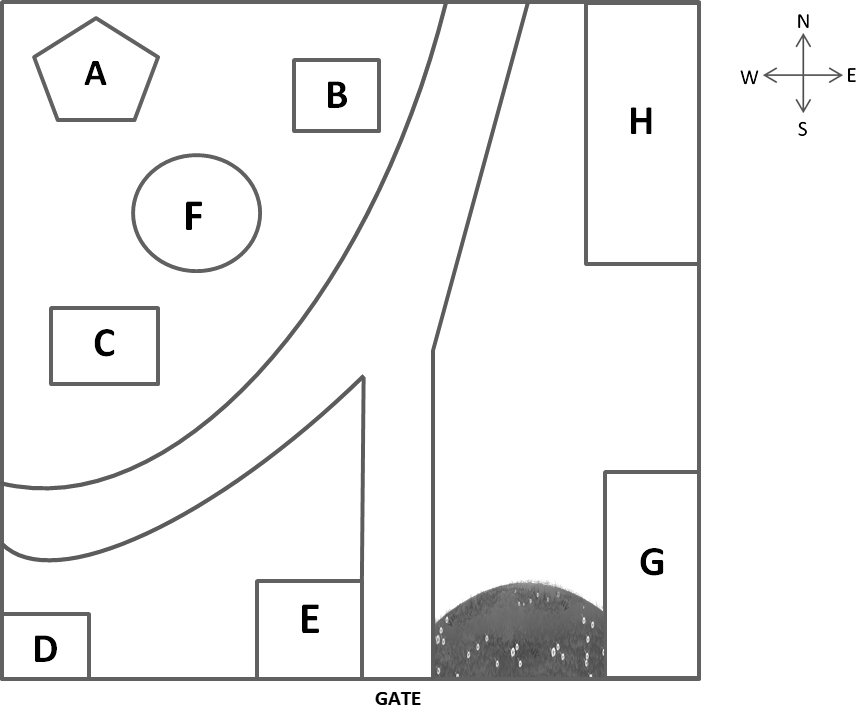
Now we're currently standing at the gate, which is marked with the arrow on the map. Now if any of you need to
visit the toilets before we get started, they're right here to our left. Out to the east, just across the grass,
there is the bird hide (Q16) where we have over one hundred species of birds for you to watch. We even have an
interactive zone where you can feed them with seed and take photographs with our parrots! What a great souvenir
to remember your trip! And up the path to the north, if you look in front of you now, there is the pye-dog zone
(Q17). Although it is closed, if any of the dogs are playing outside, you will be able to see them through the
fence. And then let's pass by the refuge. This area is a sheltered part for Brolga watchers who can use it to
spy through binoculars.
And after that, I suggest that you all visit the rest area for some cold drinks and snacks as it is very hot
outside. It is just at the northwest corner of the zoo (Q18). After that you could cut across the path to the
large rectangular hut where you will be able to see our new addition of fierce lions. The mother has just had
cubs, so it is really quite a rare thing to see! And around to the west, for those of you who want to visit
Frisbee, our native kangaroo, he is in the circular shaped hut just up the path to the left (Q19). Don't forget
to have your photo taken with him! Now, as I mentioned before, you can purchase your discounted tickets at the
photo shop and this is also where you will come to collect any photos you have had taken at the zoo during your
visit. The photo shop is located at the southwest corner of the zoo. (Q20)
Okay, ladies and gentlemen, enjoy your visit.
SECTION 3
JONES: Hello, Mr Thompson. May I speak to you for a minute?
MR THOMPSON: Of course. Please come in.
JONES: I'm Alexandra Jones. I'm studying Sustainability here at the university and I heard about the summer
course that you offer every year. I was considering joining the course and wanted to ask you some questions
about it.
MR THOMPSON: Yes, of course, please fire away.
JONES: Has the course been effective in improving the environment?
MR THOMPSON: Yes, absolutely. We have seen great results. Last year we planted a small field of trees and we
have been measuring their oxygen outputs to see the benefits that they have provided to the environment. Since
we were regulated by law last month, we are now able to hugely enhance our efforts (Q21). Our current goal is to
introduce a lot more tree species to the plot so that we can establish a complex habitat and compare the
benefits of each species. In order to do this we need to get a lot more students involved in the project, so I
am very pleased to hear about your interest.
JONES: Well, the project sounds fascinating. I would definitely like to be involved,
MR THOMPSON: Absolutely. Over the years we have received funding from private investors and from selling shares,
but the biggest improvement in our research came from a government fund that we received in the first year
(Q22). This has greatly improved the organisation and we have since won prizes for our research.
JONES: Wow, how impressive!
MR THOMPSON: Yes, it is of the utmost importance to our organisation that we find a way to repair the terrible
damage that has been done to the environment by the human species. This is no small undertaking and our
resources still need management, but from reports taken of our studies we have found that teachers and students
have greatly benefitted from field trips to the tree plantation. (Q23)
JONES: Yes, I visited the plantation myself on a field trip two years ago and I found myself greatly impressed
by it.
MR THOMPSON: We have received a lot of feedback from visiting groups telling us how impressed teachers,
researchers and students alike have been during their visits. Due to the educational facilities that we have
carefully structured, I know that the visits are useful and engaging for students and that their experience is
particularly special. (Q24)
JONES: So what is the particular focus of the organisation and the reports that it provides?
MR THOMPSON: I am personally very interested in soil erosion, so I knew that I definitely wanted to focus some
of the report on this area (Q25). Before I set up the organisation, I looked up information on what areas were
currently being researched and I found that there were already studies into air pollution and water pollution. I
obviously wanted to find a unique area to research and so these were no good. I was tempted to look into the
background of overgrazing, but the impacts of forest exploitation are far more devastating and very little
research has been carried out on this subject, so I decided that this should also form some focus for the
report. (Q26)
JONES: Yes, that makes sense. What have you found to be the greatest benefits of the activities carried out by
the organisation?
MR THOMPSON: I have found that the greatest benefits are not the ones that anyone can learn from a book, like
how to collect data, but more importantly are life lessons that one can gain only from experience. Students who
have partaken in the summer course have massively enhanced their confidence (Q27), which will prove invaluable
for the rest of their lifetime. The people who partake in the summer course already know the importance of
environmental protection, so it is not important that we spend time teaching them this. Students instead benefit
from learning the importance of punctuality, as each day they have to wake up early to make sure that they are
not late for their practical experience sessions. (Q28)
JONES: If I decide to attend the summer course, what will I be doing for the rest of the time when no activities
are going on?
MR THOMPSON: Well, we unfortunately don't yet have a library on site, so you would be unable to read reference
books although you are obviously welcome to bring some books of your own with you. We offer a range of fun
hobbies, such as games and painting, for students to participate in outside of their classes so you could
participate in one of these activities (Q29). We do not offer tutorials outside of the scheduled classes,
however you are free to interview teachers (Q30) and ask them any questions you may have about the research.
JONES: Well, the course sounds fantastic. I would definitely like to participate during the summer. Thank you so
much for your help.
MR THOMPSON: No problem at all, here is a form with all of the details. I look forward to seeing you there.
SECTION 4
Good morning. In the last few lectures I've been talking about the history of technology in the modern world.
But today I want to use Roberts as our case study, which is a company that develops complex camera technology
for a range of industries and disciplines. Since the camera was invented in 1816, it has changed and improved
dramatically with cameras now in existence that can fit on the head of a pin. The company has been founded on a
series of principals by which the company operates in its day-to-day business, the most important of these being
to enhance the present (Q31) development of camera technology.
Roberts has a philosophy pioneering and innovation, having been responsible for the invention of numerous
technologies since it was founded by Dwayne Roberts in 1957. It has achieved many of its aims over the years,
but its principal and founding aim persists through time, which is to explore new facts (Q32) and imagine the
unimaginable.
The cameras produced by Roberts have a multitude of potential applications that are currently being explored.
One of these is an anti-gravity camera that they aim to attach to a space satellite from where it will record
live, high-definition video and provide fascinating new views of planet earth. It could also prove useful in
exploring other planets (Q33) by providing researchers with never before seen images of the universe. Roberts
are also experimenting with attaching the cameras to small drones that will fly through the rainforest in search
of plants that could be used to develop future medicine (Q34). The camera also has the potential to be used on
the roads. As it is 20% cheaper than the speed cameras that are currently in operation, this means that more of
them could be distributed across the road network where they can control traffic (Q35) by making sure that all
cars abide by the speed regulations.
Despite this diverse range of potential applications, the cameras are presently used for very different, more
domestic purposes. Roberts' cameras are presently used as nanny-cams, which allow parents to watch their nannies
to ensure that they are responsibly attending to the children that they have been employed to care for. These
cameras give parents peace of mind and more control over their child's welfare whilst they are at work or
otherwise occupied. The highest sales of the company are in toys (Q36) that have the cameras hidden within them.
This clever idea means that the cameras are camouflaged from view and do not look out of place in the child's
nursery. The toys are also very robust, so children can play with them without damaging them in the process. The
toys are designed to look like animals (Q37) and come in a range of shapes, sizes and colours as well as
different animal species such as monkeys and bears. These toys are incredibly popular and can be bought in any
toy store for only $20. Always eager to be constantly improving their products, Roberts are now working on a
product that will change the way people see photography. This new contraption is a mini camera (Q38) that is
built into eyewear such as glasses and sunglasses where it can capture the world as you see it. Holiday makers
and tourists no longer have to carry a big, heavy camera around with them on their travels! They can instead
purchase a set of eyewear with the built-in camera, which will capture the moment with a simple tap.
Roberts are also developing a model of this tiny camera for use during medical procedures and operations. The
camera will be used during noninvasive keyhole surgeries to enable the surgeon to see what they are doing inside
the body without having to make a large incision. This innovative application for the camera could make
surgeries a lot faster and the saved time and energy will also make it far more efficient (Q39). As the patient
will no longer have to undergo a large incision for their surgery, it also means that their recovery will be
much faster with a greatly reduced chance of post-op infection.
If any of you have an interest in working in this field of technological invention, Roberts is a very diverse
and fast-growing company that would be a fantastic internship opportunity. Every year they organise a series of
competitions (Q40) where entrants stand the chance of winning a place in their internship programme, so I would
suggest that all of you enter.
That wraps up the lecture for today. Please remember that attendance is mandatory… [fade out]